
E-Portfolio
A road map of my academic journey. Here you will find achievements, current and future goals and information that is relevant for understanding my path forward.
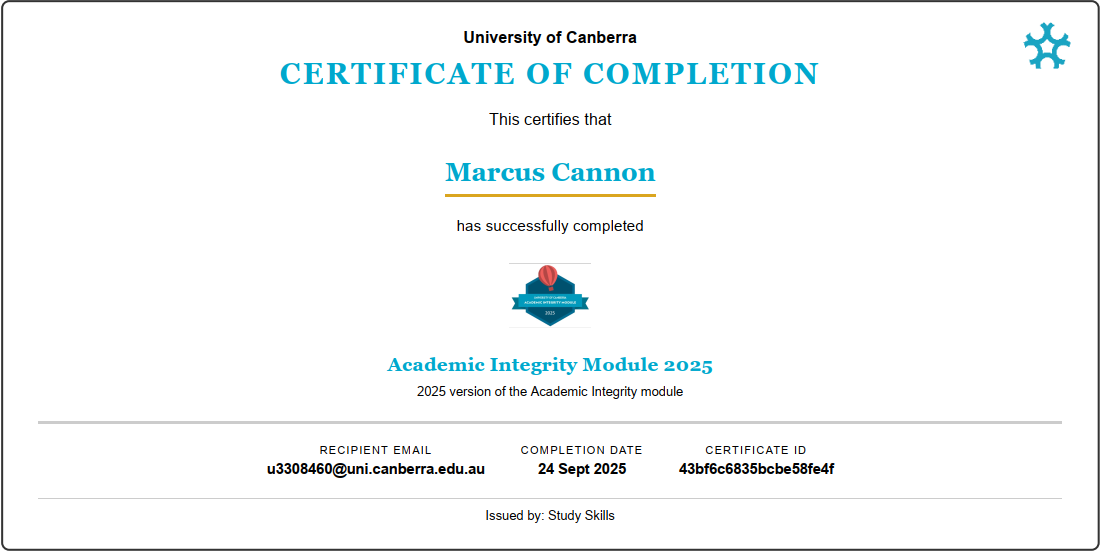
AIM CERTIFICATE
This certificate confirms my completion of the Academic Integrity Module at the University of Canberra. The course introduces the core principles of academic integrity, emphasising ethical learning, responsible research practices, and the proper acknowledgement of sources within academic work. It also addresses common challenges related to academic conduct and provides strategies for maintaining integrity throughout the learning process. Completion of this module reflects a commitment to upholding the standards of honesty, accountability, and ethical scholarship expected in higher education.
Degree: Bachelor of Creative Industry (Visual Arts)
LITERACY AREA
CORE LITERACY
RHETORICAL LITERACY
LEARNING LITERACY
EMOTIONAL LITERACY
CAREER LITERACY
ETHICAL LITERACY
DIGITAL LITERACY
SPECIFIC SKILLS/ATTRIBUTES
Believing in yourself (self-esteem)
Knowing your career strengths and challenges
Understanding how study relates to future career
Communication, leadership and teamwork
Problem solving and decision making
Goal-directed behaviour
Academic self-efficacy: Your study confidence
Learning mindset: Your ability and willingness to learn
Understanding and managing the emotions of self and others
Career mobility
Career identity and commitment
Career exploration and awareness
Upholding ethically, culturally and socially responsible behaviour
Using digital technologies for work and learning
SELF-RATING OUT OF 6
5
5
4
3
6
6
5
6
5
4
4
3
5
6
CAREER IMPORTANCE
HIGH
HIGH
HIGH
MEDIUM
HIGH
HIGH
HIGH
HIGH
MEDIUM
Medium
medium
medium
high
MEDIUM
Literacies for life worksheet
This worksheet documents the completion of a personal literacy and SWOT (Strengths, Weaknesses, Opportunities, and Threats) analysis undertaken as part of my studies at the University of Canberra. The exercise supports reflective learning by identifying areas of personal capability, potential challenges, and opportunities for development within an academic context. It provides a structured framework for evaluating personal progress and planning strategies for continued growth throughout my studies.
I believe in my ability to be self-driven in my art practice and rise to the challenges of problem solving.
STRENGTHS
MOST CONFIDENT AREAS
Learning literacy and Digital literacy.
The skills/attributes that I believe contribute to my confidence in these areas are my goal directed behaviour, willingness to learn and the wide array of digital tools I’m confident in using.
I find seeking about learning resources to be of second nature and I think these two areas work hand in hand. I’m constantly looking for ways to learn new things and digital platforms are a large part of this.
OPPORTUNITIES
My strengths allow me to take advantage of the studio space that is present at South Bank Campus. The campus has a wide range of tools that allow me to explore my art practice fully.
My weaknesses present an opportunity to push myself to interact with other artists. I keep this in mind and try to jump at the opportunity to do collaborative work when it is asked of me.
WEAKNESSES
LEAST CONFIDENT AREAS
Career literacy and Rhetorical literacy.
The skills/attribute that I believe I lack in these areas are my communication skills and my knowledge to identify career paths that might be open to me.
Working in a team can be frustrating sometimes because it can become an exercise of making everyone involved happy and that isn’t always conducive for great art. I often worry that my lack of communication will also lead to little career opportunities
THREATS
My lack of confidence in my weak areas might stop me from creating my own opportunities.
I need to be more open to creating opportunities, not just wait for them to be offered to me.
ARTIST MOTIVATION and career goals
In my art practice, I create both figurative sculptures and abstract forms, using the physical process of shaping material to explore ideas through form, texture, and structure. My artistic practice is focused on the pursuit of material understanding, the mastery of techniques and the challenge of communicating ideas that sit beyond words.
As I continue to develop my practice, I see a range of possible pathways within the arts. These include working as a freelance artist or sculptor, as well as roles within gallery environments such as curation or conservation. Rather than aiming for a single fixed outcome, I am interested in remaining open to different directions that allow me to stay engaged with both the making of art and the broader systems that support and preserve it.
five year action plan
This plan outlines a structured approach to personal, academic, and professional development over the coming years, identifying key goals and the steps required to achieve them.
time span
1 month
6 months
1 year
2 years
5 years
Goals
Keep on top of course work.
Keep improving skills in art.
Work towards art goals outside of school work like group shows.
Improve ability to engage with academic subjects.
Finish semester with good marks.
Work on personal art projects.
Start an online shop.
Solo show.
Find pathways beyond university.
Finish my Bachelors with high marks.
Find work in Art Industry.
Further education.
Be an established artist in the Brisbane area.
A career in the Art Industry.
Under-going further education.
Steps to achieve
Manage time effectively.
Put aside time for study.
Being on top of school work will give me the extra time to work towards other goals.
Read and engage with more academia.
Give assessments the time they need.
Keep managing time.
Keep making new art.
Make art that has a cohesive theme/aesthetic.
Talk to people in the industry.
Engage with all the course work.
Keep talking to people in the industry.
Find out more information about further education.
Doing group art shows.
Doing a solo show.
Engage with people in the Art Industry.